Why Soyjaking Wins Arguments- Understanding the phenomenology of Soyjakian rhetoric

https://www.countere.com/home/why-soyjaking-wins-arguments-soyjakian-rhetoric
We live in the age of argumentation.
As of the latest calculations, there are over 1.1 billion websites on the internet. A sizable chunk of them are media, opinion, and news sites. Week after week, essays and opinions are meticulously crafted to dispatch interlocutors with their razor-sharp logic. Sources are curated, synthesized, and employed to reinforce statements.
It’s admirable. I used to argue like this. I put loads of effort into forging my arguments to make sure angels themselves couldn’t pierce through my logic. But today, this effort is no better than wasted energy. It seems no one actually changes their minds post-Facebook. Rock-solid arguments are meaningless if they don’t take root in their targets. Another methodology of argumentation must be employed if one desires to win in the rhetorical colosseum; a method that cuts through the suit of baked-on layers of crusty pride and levies a lasting impact.
I stopped arguing with logic a long time ago after realizing this. Now, I soyjak to prove my point.
What many consider to be the first Soyjak, posted on November 19, 2017 in 4chan’s /v/ board.
Born from 4chan, soyjaks (often referred to as just “soys” or singularly “soy”) first appeared on the scene in 2017 as an offshoot of Wojaks. Wojak memes were around for nearly a decade before the first soyjaks emerged. Numerous ‘jak historians dispute the actual origin of soyjak; the most accepted “Out of Sweden” theory posits that the first ever soy was a .jpg file posted by a Swede, which depicted a traditional Wojak holding a Soylent bottle and sporting a navy-blue felt cap. This new soy-like Wojak was later adapted into the classic patchy-bearded, open-mouth soyjak most are now familiar with.
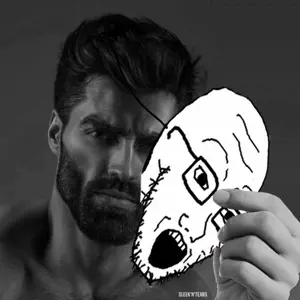
Soon, memers began to generate all kinds of soys: brainlet-soys, neckbeard-soys, and libtard-soys. Every modern-day stereotype imaginable was subject to the mockery of the soyjak. At the time of this writing there are millions of soys floating around the internet. Most normies at least know the Chad vs. Soy meme, which is hilarious in its own right.
Since then, liberal Redditors can be found unleashing their frustration when they see an offensive soy. In r/Destiny, a subreddit dedicated for fans of a popular leftist YouTuber, a post titled “Conservative party in my country posts soyjak memes about people who care about climate change” contains volumes of comments from enraged users. One comment sarcastically reads, “Post a meme back where you're the chad, and they are the soyjak. That will show them!”
Likewise in the r/TheRightCantMeme subreddit, which makes fun of reactionary memes, someone posted a meme featuring a liberal-BLM-soygirl vs. a Chad-trad family. Among the many disgruntled comments, one said “Another fine addition to the Wojack Cope gallery”, suggesting whoever created the soy was coping in some fashion. But no one knew the creator of the soy. It was the soy itself that spawned their confliction.
Here the beauty of soyjaking interlocutors is revealed. Little do these Redditors know that their offense to the ‘jak indicates its effect. The Soyjakian method of rhetoric has deep roots in psychology.
When a new soyjak is created it is meant as a type of effigy, a caricature of a common stereotype. Soyjaks are made hyper-exaggerated. Many of the brainlet-soys feature brains roasting on fires and craniums hallowed out with bottomless pits to depict someone low in intelligence. Some atheist-soys are particularly hilarious because they match the stereotype perfectly, but using artistic hyperbole. One features a soy wearing a fedora, pointing his phone at you which has some secularist trope on it. My personal favorite is the Hiroshima-nuke-brainlet-soy.
However, this hyper-exaggeration is only an exaggeration to the creator or user of the soy. To the one taking offense to the soy, they do not see a hyper-exaggeration. They see a hyper-accurate depiction of what they truly are. The soy is hyper-real—it’s a condensed actualization of the truest self of the one who takes offense to it. The offender knows this. Their frustration arises from encountering their true self in the outside world.
Carl Jung (the founder of analytical psychology) would say the self is unmasked. Jung sheds light on how confronting the self isn’t easy by expounding on the reflectional properties of water: “Whoever looks into the mirror of the water will see first of all his own face. Whoever goes to himself risks a confrontation with himself. The mirror does not flatter, it faithfully shows whatever looks into it; namely, the face we never show to the world because we cover it with the persona, the mask of the actor. But the mirror lies behind the mask and shows the true face.”
Jung’s analogy is perfect. Here we can see the mechanism of how soyjaking destroys interlocutors from the inside out. The soyjak reflects the most inner part of those who take offense to them, which must then be destroyed, not because the soy is inaccurate, but because it is accurate. On a phenomenological level, the self is not encountered in everyday life. The self can be avoided, and is purposely avoided—hence the masks Jung speaks of.
When you put on a mask you play a trick on the outside world, but you also trick yourself. It’s a type of inner LARPing. Thus, a cognitive dissonance can easily be employed to avoid one’s demons and inner contradictions. Subjective phenomena (emotions, intuitions, moral thoughts, epiphanies, things of that nature) can be explained away ad hoc to avoid the reality that they might be something generated from the self. So in order to unmask someone, their self must be perceived in objective, real-time.
The realism of the soyjak does precisely this. The soyjak is a hyper-condensation of the victim’s truest form that has tried to bust through in their mind for so long—which they’ve run from willingly and knowingly—but was brushed aside with denial.
The aforementioned Redditor are prime examples of the soy’s rhetorical power. The Redditor who claimed the soyjak memers were “coping” by creating the soyjaks is “coping” themselves. If the Reddit took no offense, it would mean the self was not accurately depicted in the soy. But alas, the user’s pride was damaged. A chink in the armor was opened; all it took was an encounter with himself. The counter-attack only affirms the effect of the ‘jak.
One last example of soyjakian rhetoric is when I saw someone trying to call one of my friends a non-Christian on my Twitter timeline. In the Christian world, there's a stinking debacle over how Christians ought to interact with government and/or wield political power. My friend is one of those who think that Christians can, and ought, call government authorities to repentance. This line of political reasoning is new to many Christians, and he received knee-jerk reactions calling him a non-Christian, as if holding a certain political philosophy would anathematize him.
This was obviously a half-witted take. I could have replied that my friend is a baptized Christian who verifiably bears the fruit of living faith. But surely this wouldn’t have changed their mind about my friend. My counter-arguments would only reaffirm their stubbornness. In using an ultra rare buy-the-top-sell-the-bottom soyjak, I exposed them for what they already knew in their heart of hearts before typing out the tweet: that the tweet was void of the slightest ounce of sensibility. Below you can see their reaction.
As you can see, it’s hard to even make out what they’re saying. Something about the Talmud and Yoram Hazony? This is pure cognitive dissonance, observed in the wild.
If you’ve scrolled Facebook or Twitter for a few minutes, you understand that the most air-tight argumentation is futile today. We’re all shells trying to protect the pride. Our armor is made of the hardest steel. This is why soyjaking is the only way to win in the rhetorical colosseum. Indeed, in the internet-age, those with the deepest soy folder will have the best arguments.
 5
 2
 1



em dash

2 sentence summarization by grok:
"We live in an age of endless online arguments where traditional logic and well-sourced essays rarely change minds, as people’s pride and personas make them resistant to persuasion.Instead, “soyjaking” — using exaggerated, mocking Soyjak memes as rhetorical weapons — wins by directly confronting the target with a hyper-real caricature of their true self, triggering cognitive dissonance and unmasking their inner contradictions far more effectively than logic ever could."
"We live in an age of endless online arguments where traditional logic and well-sourced essays rarely change minds, as people’s pride and personas make them resistant to persuasion.Instead, “soyjaking” — using exaggerated, mocking Soyjak memes as rhetorical weapons — wins by directly confronting the target with a hyper-real caricature of their true self, triggering cognitive dissonance and unmasking their inner contradictions far more effectively than logic ever could."
>https://www.countere.com/home/why-soyjaking-wins-arguments-soyjakian-rhetoric
>We live in the age of argumentation.
>As of the latest calculations, there are over 1.1 billion websites on the internet. A sizable chunk of them are media, opinion, and news sites. Week after week, essays and opinions are meticulously crafted to dispatch interlocutors with their razor-sharp logic. Sources are curated, synthesized, and employed to reinforce statements.
>It’s admirable. I used to argue like this. I put loads of effort into forging my arguments to make sure angels themselves couldn’t pierce through my logic. But today, this effort is no better than wasted energy. It seems no one actually changes their minds post-Facebook. Rock-solid arguments are meaningless if they don’t take root in their targets. Another methodology of argumentation must be employed if one desires to win in the rhetorical colosseum; a method that cuts through the suit of baked-on layers of crusty pride and levies a lasting impact.
>I stopped arguing with logic a long time ago after realizing this. Now, I soyjak to prove my point.
>What many consider to be the first Soyjak, posted on November 19, 2017 in 4chan’s /v/ board.
>Born from 4chan, soyjaks (often referred to as just “soys” or singularly “soy”) first appeared on the scene in 2017 as an offshoot of Wojaks. Wojak memes were around for nearly a decade before the first soyjaks emerged. Numerous ‘jak historians dispute the actual origin of soyjak; the most accepted “Out of Sweden” theory posits that the first ever soy was a .jpg file posted by a Swede, which depicted a traditional Wojak holding a Soylent bottle and sporting a navy-blue felt cap. This new soy-like Wojak was later adapted into the classic patchy-bearded, open-mouth soyjak most are now familiar with.
>Soon, memers began to generate all kinds of soys: brainlet-soys, neckbeard-soys, and libtard-soys. Every modern-day stereotype imaginable was subject to the mockery of the soyjak. At the time of this writing there are millions of soys floating around the internet. Most normies at least know the Chad vs. Soy meme, which is hilarious in its own right.
>Since then, liberal Redditors can be found unleashing their frustration when they see an offensive soy. In r/Destiny, a subreddit dedicated for fans of a popular leftist YouTuber, a post titled “Conservative party in my country posts soyjak memes about people who care about climate change” contains volumes of comments from enraged users. One comment sarcastically reads, “Post a meme back where you're the chad, and they are the soyjak. That will show them!”
>Likewise in the r/TheRightCantMeme subreddit, which makes fun of reactionary memes, someone posted a meme featuring a liberal-BLM-soygirl vs. a Chad-trad family. Among the many disgruntled comments, one said “Another fine addition to the Wojack Cope gallery”, suggesting whoever created the soy was coping in some fashion. But no one knew the creator of the soy. It was the soy itself that spawned their confliction.
>Here the beauty of soyjaking interlocutors is revealed. Little do these Redditors know that their offense to the ‘jak indicates its effect. The Soyjakian method of rhetoric has deep roots in psychology.
>When a new soyjak is created it is meant as a type of effigy, a caricature of a common stereotype. Soyjaks are made hyper-exaggerated. Many of the brainlet-soys feature brains roasting on fires and craniums hallowed out with bottomless pits to depict someone low in intelligence. Some atheist-soys are particularly hilarious because they match the stereotype perfectly, but using artistic hyperbole. One features a soy wearing a fedora, pointing his phone at you which has some secularist trope on it. My personal favorite is the Hiroshima-nuke-brainlet-soy.
>However, this hyper-exaggeration is only an exaggeration to the creator or user of the soy. To the one taking offense to the soy, they do not see a hyper-exaggeration. They see a hyper-accurate depiction of what they truly are. The soy is hyper-real—it’s a condensed actualization of the truest self of the one who takes offense to it. The offender knows this. Their frustration arises from encountering their true self in the outside world.
>Carl Jung (the founder of analytical psychology) would say the self is unmasked. Jung sheds light on how confronting the self isn’t easy by expounding on the reflectional properties of water: “Whoever looks into the mirror of the water will see first of all his own face. Whoever goes to himself risks a confrontation with himself. The mirror does not flatter, it faithfully shows whatever looks into it; namely, the face we never show to the world because we cover it with the persona, the mask of the actor. But the mirror lies behind the mask and shows the true face.”
>Jung’s analogy is perfect. Here we can see the mechanism of how soyjaking destroys interlocutors from the inside out. The soyjak reflects the most inner part of those who take offense to them, which must then be destroyed, not because the soy is inaccurate, but because it is accurate. On a phenomenological level, the self is not encountered in everyday life. The self can be avoided, and is purposely avoided—hence the masks Jung speaks of.
>When you put on a mask you play a trick on the outside world, but you also trick yourself. It’s a type of inner LARPing. Thus, a cognitive dissonance can easily be employed to avoid one’s demons and inner contradictions. Subjective phenomena (emotions, intuitions, moral thoughts, epiphanies, things of that nature) can be explained away ad hoc to avoid the reality that they might be something generated from the self. So in order to unmask someone, their self must be perceived in objective, real-time.
>The realism of the soyjak does precisely this. The soyjak is a hyper-condensation of the victim’s truest form that has tried to bust through in their mind for so long—which they’ve run from willingly and knowingly—but was brushed aside with denial.
>The aforementioned Redditor are prime examples of the soy’s rhetorical power. The Redditor who claimed the soyjak memers were “coping” by creating the soyjaks is “coping” themselves. If the Reddit took no offense, it would mean the self was not accurately depicted in the soy. But alas, the user’s pride was damaged. A chink in the armor was opened; all it took was an encounter with himself. The counter-attack only affirms the effect of the ‘jak.
>One last example of soyjakian rhetoric is when I saw someone trying to call one of my friends a non-Christian on my Twitter timeline. In the Christian world, there's a stinking debacle over how Christians ought to interact with government and/or wield political power. My friend is one of those who think that Christians can, and ought, call government authorities to repentance. This line of political reasoning is new to many Christians, and he received knee-jerk reactions calling him a non-Christian, as if holding a certain political philosophy would anathematize him.
>This was obviously a half-witted take. I could have replied that my friend is a baptized Christian who verifiably bears the fruit of living faith. But surely this wouldn’t have changed their mind about my friend. My counter-arguments would only reaffirm their stubbornness. In using an ultra rare buy-the-top-sell-the-bottom soyjak, I exposed them for what they already knew in their heart of hearts before typing out the tweet: that the tweet was void of the slightest ounce of sensibility. Below you can see their reaction.
>As you can see, it’s hard to even make out what they’re saying. Something about the Talmud and Yoram Hazony? This is pure cognitive dissonance, observed in the wild.
>If you’ve scrolled Facebook or Twitter for a few minutes, you understand that the most air-tight argumentation is futile today. We’re all shells trying to protect the pride. Our armor is made of the hardest steel. This is why soyjaking is the only way to win in the rhetorical colosseum. Indeed, in the internet-age, those with the deepest soy folder will have the best arguments
do a 19 sentence summary2 sentence summarization by grok:
"We live in an age of endless online arguments where traditional logic and well-sourced essays rarely change minds, as people’s pride and personas make them resistant to persuasion.Instead, “soyjaking” — using exaggerated, mocking Soyjak memes as rhetorical weapons — wins by directly confronting the target with a hyper-real caricature of their true self, triggering cognitive dissonance and unmasking their inner contradictions far more effectively than logic ever could."

UltraFentReactor67
No sé
@grok explain this in two words i can't read2 sentence summarization by grok:
"We live in an age of endless online arguments where traditional logic and well-sourced essays rarely change minds, as people’s pride and personas make them resistant to persuasion.Instead, “soyjaking” — using exaggerated, mocking Soyjak memes as rhetorical weapons — wins by directly confronting the target with a hyper-real caricature of their true self, triggering cognitive dissonance and unmasking their inner contradictions far more effectively than logic ever could."
Soyjacks
"Soyjaking wins."@grok explain this in two words i can't readShow quoted text
2 sentence summarization by grok:
"We live in an age of endless online arguments where traditional logic and well-sourced essays rarely change minds, as people’s pride and personas make them resistant to persuasion.Instead, “soyjaking” — using exaggerated, mocking Soyjak memes as rhetorical weapons — wins by directly confronting the target with a hyper-real caricature of their true self, triggering cognitive dissonance and unmasking their inner contradictions far more effectively than logic ever could."


Granite
JSID, also quote is an actual depressed pedophile faggot who wants to end it all if that matters
ferret grok is locked behind paywall@grok explain this in two words i can't readShow quoted text
2 sentence summarization by grok:
"We live in an age of endless online arguments where traditional logic and well-sourced essays rarely change minds, as people’s pride and personas make them resistant to persuasion.Instead, “soyjaking” — using exaggerated, mocking Soyjak memes as rhetorical weapons — wins by directly confronting the target with a hyper-real caricature of their true self, triggering cognitive dissonance and unmasking their inner contradictions far more effectively than logic ever could."

"We live in the age of argumentation, with over 1.1 billion websites, many dedicated to crafting detailed essays and opinions backed by sources and logic. People once invested great effort into building airtight arguments that seemed impenetrable. However, such logical arguments often fail because no one truly changes their mind in online debates, especially after the rise of social media like Facebook. Traditional rhetoric has become wasted energy since solid points rarely take root in the target audience. A new method is needed to cut through layers of pride and deliver a lasting impact in the rhetorical battlefield. The author stopped using pure logic long ago and now relies on “soyjaking” to prove points. Soyjaks originated on 4chan in 2017 as an offshoot of Wojak memes, with the first one reportedly posted by a Swede depicting a Wojak with a Soylent bottle and felt cap. They evolved into the familiar patchy-bearded, open-mouthed soyjak and spawned countless variations like brainlet-soys, neckbeard-soys, and libtard-soys that mock modern stereotypes. Millions of soyjaks now exist online, and many people recognize the classic Chad vs. Soy meme format. Redditors often react with frustration and outrage when encountering offensive soyjaks in subreddits like r/Destiny or r/TheRightCantMeme. Their angry responses, such as accusing creators of “coping,” actually reveal the soyjak’s psychological power rather than dismiss it. Soyjaks function as exaggerated effigies or caricatures of stereotypes, hyperbolized with elements like roasting brains or hollow craniums to depict low intelligence or other traits. To the creator, these are humorous exaggerations, but to the offended person, the soyjak feels like a hyper-accurate, condensed mirror of their true self. This confrontation triggers frustration because it forces an encounter with the inner self that people normally avoid through masks and personas, as described by Carl Jung. Jung’s metaphor of the water mirror shows how confronting one’s unmasked face is uncomfortable, revealing what lies behind the actor’s mask. Soyjaking unmasks people by presenting their truest form objectively in real time, breaking through cognitive dissonance and inner LARPing that allows denial of personal contradictions. The soyjak acts as a hyper-condensation of the denied inner self, making denial harder and exposing pride’s armor. In one example, responding to a flawed accusation against a friend with a rare soyjak provoked incoherent, dissonant replies involving unrelated topics like the Talmud. Traditional logic would only reinforce stubbornness, but the soyjak immediately exposed the accuser’s lack of sensibility. Ultimately, in today’s online environment where everyone protects their pride with steel-like armor, soyjaking proves more effective than airtight arguments. Those with the deepest collection of soyjaks hold the strongest rhetorical advantage in the internet-age colosseum."do a 19 sentence summaryShow quoted text
2 sentence summarization by grok:
"We live in an age of endless online arguments where traditional logic and well-sourced essays rarely change minds, as people’s pride and personas make them resistant to persuasion.Instead, “soyjaking” — using exaggerated, mocking Soyjak memes as rhetorical weapons — wins by directly confronting the target with a hyper-real caricature of their true self, triggering cognitive dissonance and unmasking their inner contradictions far more effectively than logic ever could."
@grok give me a 67 sentence summary

Unscerost
Mining for coal
SECA2 sentence summarization by grok:
"We live in an age of endless online arguments where traditional logic and well-sourced essays rarely change minds, as people’s pride and personas make them resistant to persuasion.Instead, “soyjaking” — using exaggerated, mocking Soyjak memes as rhetorical weapons — wins by directly confronting the target with a hyper-real caricature of their true self, triggering cognitive dissonance and unmasking their inner contradictions far more effectively than logic ever could."

Obsidian
600
>https://www.countere.com/home/why-soyjaking-wins-arguments-soyjakian-rhetoric
>We live in the age of argumentation.
As of the latest calculations, there are over 1.1 billion websites on the internet. A sizable chunk of them are media, opinion, and news sites. Week after week, essays and opinions are meticulously crafted to dispatch interlocutors with their razor-sharp logic. Sources are curated, synthesized, and employed to reinforce statements.
It’s admirable. I used to argue like this. I put loads of effort into forging my arguments to make sure angels themselves couldn’t pierce through my logic. But today, this effort is no better than wasted energy. It seems no one actually changes their minds post-Facebook. Rock-solid arguments are meaningless if they don’t take root in their targets. Another methodology of argumentation must be employed if one desires to win in the rhetorical colosseum; a method that cuts through the suit of baked-on layers of crusty pride and levies a lasting impact.
I stopped arguing with logic a long time ago after realizing this. Now, I soyjak to prove my point.
What many consider to be the first Soyjak, posted on November 19, 2017 in 4chan’s /v/ board.
Born from 4chan, soyjaks (often referred to as just “soys” or singularly “soy”) first appeared on the scene in 2017 as an offshoot of Wojaks. Wojak memes were around for nearly a decade before the first soyjaks emerged. Numerous ‘jak historians dispute the actual origin of soyjak; the most accepted “Out of Sweden” theory posits that the first ever soy was a .jpg file posted by a Swede, which depicted a traditional Wojak holding a Soylent bottle and sporting a navy-blue felt cap. This new soy-like Wojak was later adapted into the classic patchy-bearded, open-mouth soyjak most are now familiar with.
Soon, memers began to generate all kinds of soys: brainlet-soys, neckbeard-soys, and libtard-soys. Every modern-day stereotype imaginable was subject to the mockery of the soyjak. At the time of this writing there are millions of soys floating around the internet. Most normies at least know the Chad vs. Soy meme, which is hilarious in its own right.
Since then, liberal Redditors can be found unleashing their frustration when they see an offensive soy. In r/Destiny, a subreddit dedicated for fans of a popular leftist YouTuber, a post titled “Conservative party in my country posts soyjak memes about people who care about climate change” contains volumes of comments from enraged users. One comment sarcastically reads, “Post a meme back where you're the chad, and they are the soyjak. That will show them!”
Likewise in the r/TheRightCantMeme subreddit, which makes fun of reactionary memes, someone posted a meme featuring a liberal-BLM-soygirl vs. a Chad-trad family. Among the many disgruntled comments, one said “Another fine addition to the Wojack Cope gallery”, suggesting whoever created the soy was coping in some fashion. But no one knew the creator of the soy. It was the soy itself that spawned their confliction.
Here the beauty of soyjaking interlocutors is revealed. Little do these Redditors know that their offense to the ‘jak indicates its effect. The Soyjakian method of rhetoric has deep roots in psychology.
When a new soyjak is created it is meant as a type of effigy, a caricature of a common stereotype. Soyjaks are made hyper-exaggerated. Many of the brainlet-soys feature brains roasting on fires and craniums hallowed out with bottomless pits to depict someone low in intelligence. Some atheist-soys are particularly hilarious because they match the stereotype perfectly, but using artistic hyperbole. One features a soy wearing a fedora, pointing his phone at you which has some secularist trope on it. My personal favorite is the Hiroshima-nuke-brainlet-soy.
However, this hyper-exaggeration is only an exaggeration to the creator or user of the soy. To the one taking offense to the soy, they do not see a hyper-exaggeration. They see a hyper-accurate depiction of what they truly are. The soy is hyper-real—it’s a condensed actualization of the truest self of the one who takes offense to it. The offender knows this. Their frustration arises from encountering their true self in the outside world.
Carl Jung (the founder of analytical psychology) would say the self is unmasked. Jung sheds light on how confronting the self isn’t easy by expounding on the reflectional properties of water: “Whoever looks into the mirror of the water will see first of all his own face. Whoever goes to himself risks a confrontation with himself. The mirror does not flatter, it faithfully shows whatever looks into it; namely, the face we never show to the world because we cover it with the persona, the mask of the actor. But the mirror lies behind the mask and shows the true face.”
Jung’s analogy is perfect. Here we can see the mechanism of how soyjaking destroys interlocutors from the inside out. The soyjak reflects the most inner part of those who take offense to them, which must then be destroyed, not because the soy is inaccurate, but because it is accurate. On a phenomenological level, the self is not encountered in everyday life. The self can be avoided, and is purposely avoided—hence the masks Jung speaks of.
When you put on a mask you play a trick on the outside world, but you also trick yourself. It’s a type of inner LARPing. Thus, a cognitive dissonance can easily be employed to avoid one’s demons and inner contradictions. Subjective phenomena (emotions, intuitions, moral thoughts, epiphanies, things of that nature) can be explained away ad hoc to avoid the reality that they might be something generated from the self. So in order to unmask someone, their self must be perceived in objective, real-time.
The realism of the soyjak does precisely this. The soyjak is a hyper-condensation of the victim’s truest form that has tried to bust through in their mind for so long—which they’ve run from willingly and knowingly—but was brushed aside with denial.
The aforementioned Redditor are prime examples of the soy’s rhetorical power. The Redditor who claimed the soyjak memers were “coping” by creating the soyjaks is “coping” themselves. If the Reddit took no offense, it would mean the self was not accurately depicted in the soy. But alas, the user’s pride was damaged. A chink in the armor was opened; all it took was an encounter with himself. The counter-attack only affirms the effect of the ‘jak.
One last example of soyjakian rhetoric is when I saw someone trying to call one of my friends a non-Christian on my Twitter timeline. In the Christian world, there's a stinking debacle over how Christians ought to interact with government and/or wield political power. My friend is one of those who think that Christians can, and ought, call government authorities to repentance. This line of political reasoning is new to many Christians, and he received knee-jerk reactions calling him a non-Christian, as if holding a certain political philosophy would anathematize him.
This was obviously a half-witted take. I could have replied that my friend is a baptized Christian who verifiably bears the fruit of living faith. But surely this wouldn’t have changed their mind about my friend. My counter-arguments would only reaffirm their stubbornness. In using an ultra rare buy-the-top-sell-the-bottom soyjak, I exposed them for what they already knew in their heart of hearts before typing out the tweet: that the tweet was void of the slightest ounce of sensibility. Below you can see their reaction.
As you can see, it’s hard to even make out what they’re saying. Something about the Talmud and Yoram Hazony? This is pure cognitive dissonance, observed in the wild.
If you’ve scrolled Facebook or Twitter for a few minutes, you understand that the most air-tight argumentation is futile today. We’re all shells trying to protect the pride. Our armor is made of the hardest steel. This is why soyjaking is the only way to win in the rhetorical colosseum. Indeed, in the internet-age, those with the deepest soy folder will have the best arguments.
>We live in the age of argumentation.
As of the latest calculations, there are over 1.1 billion websites on the internet. A sizable chunk of them are media, opinion, and news sites. Week after week, essays and opinions are meticulously crafted to dispatch interlocutors with their razor-sharp logic. Sources are curated, synthesized, and employed to reinforce statements.
It’s admirable. I used to argue like this. I put loads of effort into forging my arguments to make sure angels themselves couldn’t pierce through my logic. But today, this effort is no better than wasted energy. It seems no one actually changes their minds post-Facebook. Rock-solid arguments are meaningless if they don’t take root in their targets. Another methodology of argumentation must be employed if one desires to win in the rhetorical colosseum; a method that cuts through the suit of baked-on layers of crusty pride and levies a lasting impact.
I stopped arguing with logic a long time ago after realizing this. Now, I soyjak to prove my point.
What many consider to be the first Soyjak, posted on November 19, 2017 in 4chan’s /v/ board.
Born from 4chan, soyjaks (often referred to as just “soys” or singularly “soy”) first appeared on the scene in 2017 as an offshoot of Wojaks. Wojak memes were around for nearly a decade before the first soyjaks emerged. Numerous ‘jak historians dispute the actual origin of soyjak; the most accepted “Out of Sweden” theory posits that the first ever soy was a .jpg file posted by a Swede, which depicted a traditional Wojak holding a Soylent bottle and sporting a navy-blue felt cap. This new soy-like Wojak was later adapted into the classic patchy-bearded, open-mouth soyjak most are now familiar with.
Soon, memers began to generate all kinds of soys: brainlet-soys, neckbeard-soys, and libtard-soys. Every modern-day stereotype imaginable was subject to the mockery of the soyjak. At the time of this writing there are millions of soys floating around the internet. Most normies at least know the Chad vs. Soy meme, which is hilarious in its own right.
Since then, liberal Redditors can be found unleashing their frustration when they see an offensive soy. In r/Destiny, a subreddit dedicated for fans of a popular leftist YouTuber, a post titled “Conservative party in my country posts soyjak memes about people who care about climate change” contains volumes of comments from enraged users. One comment sarcastically reads, “Post a meme back where you're the chad, and they are the soyjak. That will show them!”
Likewise in the r/TheRightCantMeme subreddit, which makes fun of reactionary memes, someone posted a meme featuring a liberal-BLM-soygirl vs. a Chad-trad family. Among the many disgruntled comments, one said “Another fine addition to the Wojack Cope gallery”, suggesting whoever created the soy was coping in some fashion. But no one knew the creator of the soy. It was the soy itself that spawned their confliction.
Here the beauty of soyjaking interlocutors is revealed. Little do these Redditors know that their offense to the ‘jak indicates its effect. The Soyjakian method of rhetoric has deep roots in psychology.
When a new soyjak is created it is meant as a type of effigy, a caricature of a common stereotype. Soyjaks are made hyper-exaggerated. Many of the brainlet-soys feature brains roasting on fires and craniums hallowed out with bottomless pits to depict someone low in intelligence. Some atheist-soys are particularly hilarious because they match the stereotype perfectly, but using artistic hyperbole. One features a soy wearing a fedora, pointing his phone at you which has some secularist trope on it. My personal favorite is the Hiroshima-nuke-brainlet-soy.
However, this hyper-exaggeration is only an exaggeration to the creator or user of the soy. To the one taking offense to the soy, they do not see a hyper-exaggeration. They see a hyper-accurate depiction of what they truly are. The soy is hyper-real—it’s a condensed actualization of the truest self of the one who takes offense to it. The offender knows this. Their frustration arises from encountering their true self in the outside world.
Carl Jung (the founder of analytical psychology) would say the self is unmasked. Jung sheds light on how confronting the self isn’t easy by expounding on the reflectional properties of water: “Whoever looks into the mirror of the water will see first of all his own face. Whoever goes to himself risks a confrontation with himself. The mirror does not flatter, it faithfully shows whatever looks into it; namely, the face we never show to the world because we cover it with the persona, the mask of the actor. But the mirror lies behind the mask and shows the true face.”
Jung’s analogy is perfect. Here we can see the mechanism of how soyjaking destroys interlocutors from the inside out. The soyjak reflects the most inner part of those who take offense to them, which must then be destroyed, not because the soy is inaccurate, but because it is accurate. On a phenomenological level, the self is not encountered in everyday life. The self can be avoided, and is purposely avoided—hence the masks Jung speaks of.
When you put on a mask you play a trick on the outside world, but you also trick yourself. It’s a type of inner LARPing. Thus, a cognitive dissonance can easily be employed to avoid one’s demons and inner contradictions. Subjective phenomena (emotions, intuitions, moral thoughts, epiphanies, things of that nature) can be explained away ad hoc to avoid the reality that they might be something generated from the self. So in order to unmask someone, their self must be perceived in objective, real-time.
The realism of the soyjak does precisely this. The soyjak is a hyper-condensation of the victim’s truest form that has tried to bust through in their mind for so long—which they’ve run from willingly and knowingly—but was brushed aside with denial.
The aforementioned Redditor are prime examples of the soy’s rhetorical power. The Redditor who claimed the soyjak memers were “coping” by creating the soyjaks is “coping” themselves. If the Reddit took no offense, it would mean the self was not accurately depicted in the soy. But alas, the user’s pride was damaged. A chink in the armor was opened; all it took was an encounter with himself. The counter-attack only affirms the effect of the ‘jak.
One last example of soyjakian rhetoric is when I saw someone trying to call one of my friends a non-Christian on my Twitter timeline. In the Christian world, there's a stinking debacle over how Christians ought to interact with government and/or wield political power. My friend is one of those who think that Christians can, and ought, call government authorities to repentance. This line of political reasoning is new to many Christians, and he received knee-jerk reactions calling him a non-Christian, as if holding a certain political philosophy would anathematize him.
This was obviously a half-witted take. I could have replied that my friend is a baptized Christian who verifiably bears the fruit of living faith. But surely this wouldn’t have changed their mind about my friend. My counter-arguments would only reaffirm their stubbornness. In using an ultra rare buy-the-top-sell-the-bottom soyjak, I exposed them for what they already knew in their heart of hearts before typing out the tweet: that the tweet was void of the slightest ounce of sensibility. Below you can see their reaction.
As you can see, it’s hard to even make out what they’re saying. Something about the Talmud and Yoram Hazony? This is pure cognitive dissonance, observed in the wild.
If you’ve scrolled Facebook or Twitter for a few minutes, you understand that the most air-tight argumentation is futile today. We’re all shells trying to protect the pride. Our armor is made of the hardest steel. This is why soyjaking is the only way to win in the rhetorical colosseum. Indeed, in the internet-age, those with the deepest soy folder will have the best arguments.
UltraFentReactor67
No sé


>https://www.countere.com/home/why-soyjaking-wins-arguments-soyjakian-rhetoric
>We live in the age of argumentation.
>As of the latest calculations, there are over 1.1 billion websites on the internet. A sizable chunk of them are media, opinion, and news sites. Week after week, essays and opinions are meticulously crafted to dispatch interlocutors with their razor-sharp logic. Sources are curated, synthesized, and employed to reinforce statements.
>It’s admirable. I used to argue like this. I put loads of effort into forging my arguments to make sure angels themselves couldn’t pierce through my logic. But today, this effort is no better than wasted energy. It seems no one actually changes their minds post-Facebook. Rock-solid arguments are meaningless if they don’t take root in their targets. Another methodology of argumentation must be employed if one desires to win in the rhetorical colosseum; a method that cuts through the suit of baked-on layers of crusty pride and levies a lasting impact.
>I stopped arguing with logic a long time ago after realizing this. Now, I soyjak to prove my point.
>What many consider to be the first Soyjak, posted on November 19, 2017 in 4chan’s /v/ board.
>Born from 4chan, soyjaks (often referred to as just “soys” or singularly “soy”) first appeared on the scene in 2017 as an offshoot of Wojaks. Wojak memes were around for nearly a decade before the first soyjaks emerged. Numerous ‘jak historians dispute the actual origin of soyjak; the most accepted “Out of Sweden” theory posits that the first ever soy was a .jpg file posted by a Swede, which depicted a traditional Wojak holding a Soylent bottle and sporting a navy-blue felt cap. This new soy-like Wojak was later adapted into the classic patchy-bearded, open-mouth soyjak most are now familiar with.
>Soon, memers began to generate all kinds of soys: brainlet-soys, neckbeard-soys, and libtard-soys. Every modern-day stereotype imaginable was subject to the mockery of the soyjak. At the time of this writing there are millions of soys floating around the internet. Most normies at least know the Chad vs. Soy meme, which is hilarious in its own right.
>Since then, liberal Redditors can be found unleashing their frustration when they see an offensive soy. In r/Destiny, a subreddit dedicated for fans of a popular leftist YouTuber, a post titled “Conservative party in my country posts soyjak memes about people who care about climate change” contains volumes of comments from enraged users. One comment sarcastically reads, “Post a meme back where you're the chad, and they are the soyjak. That will show them!”
>Likewise in the r/TheRightCantMeme subreddit, which makes fun of reactionary memes, someone posted a meme featuring a liberal-BLM-soygirl vs. a Chad-trad family. Among the many disgruntled comments, one said “Another fine addition to the Wojack Cope gallery”, suggesting whoever created the soy was coping in some fashion. But no one knew the creator of the soy. It was the soy itself that spawned their confliction.
>Here the beauty of soyjaking interlocutors is revealed. Little do these Redditors know that their offense to the ‘jak indicates its effect. The Soyjakian method of rhetoric has deep roots in psychology.
>When a new soyjak is created it is meant as a type of effigy, a caricature of a common stereotype. Soyjaks are made hyper-exaggerated. Many of the brainlet-soys feature brains roasting on fires and craniums hallowed out with bottomless pits to depict someone low in intelligence. Some atheist-soys are particularly hilarious because they match the stereotype perfectly, but using artistic hyperbole. One features a soy wearing a fedora, pointing his phone at you which has some secularist trope on it. My personal favorite is the Hiroshima-nuke-brainlet-soy.
>However, this hyper-exaggeration is only an exaggeration to the creator or user of the soy. To the one taking offense to the soy, they do not see a hyper-exaggeration. They see a hyper-accurate depiction of what they truly are. The soy is hyper-real—it’s a condensed actualization of the truest self of the one who takes offense to it. The offender knows this. Their frustration arises from encountering their true self in the outside world.
>Carl Jung (the founder of analytical psychology) would say the self is unmasked. Jung sheds light on how confronting the self isn’t easy by expounding on the reflectional properties of water: “Whoever looks into the mirror of the water will see first of all his own face. Whoever goes to himself risks a confrontation with himself. The mirror does not flatter, it faithfully shows whatever looks into it; namely, the face we never show to the world because we cover it with the persona, the mask of the actor. But the mirror lies behind the mask and shows the true face.”
>Jung’s analogy is perfect. Here we can see the mechanism of how soyjaking destroys interlocutors from the inside out. The soyjak reflects the most inner part of those who take offense to them, which must then be destroyed, not because the soy is inaccurate, but because it is accurate. On a phenomenological level, the self is not encountered in everyday life. The self can be avoided, and is purposely avoided—hence the masks Jung speaks of.
>When you put on a mask you play a trick on the outside world, but you also trick yourself. It’s a type of inner LARPing. Thus, a cognitive dissonance can easily be employed to avoid one’s demons and inner contradictions. Subjective phenomena (emotions, intuitions, moral thoughts, epiphanies, things of that nature) can be explained away ad hoc to avoid the reality that they might be something generated from the self. So in order to unmask someone, their self must be perceived in objective, real-time.
>The realism of the soyjak does precisely this. The soyjak is a hyper-condensation of the victim’s truest form that has tried to bust through in their mind for so long—which they’ve run from willingly and knowingly—but was brushed aside with denial.
>The aforementioned Redditor are prime examples of the soy’s rhetorical power. The Redditor who claimed the soyjak memers were “coping” by creating the soyjaks is “coping” themselves. If the Reddit took no offense, it would mean the self was not accurately depicted in the soy. But alas, the user’s pride was damaged. A chink in the armor was opened; all it took was an encounter with himself. The counter-attack only affirms the effect of the ‘jak.
>One last example of soyjakian rhetoric is when I saw someone trying to call one of my friends a non-Christian on my Twitter timeline. In the Christian world, there's a stinking debacle over how Christians ought to interact with government and/or wield political power. My friend is one of those who think that Christians can, and ought, call government authorities to repentance. This line of political reasoning is new to many Christians, and he received knee-jerk reactions calling him a non-Christian, as if holding a certain political philosophy would anathematize him.
>This was obviously a half-witted take. I could have replied that my friend is a baptized Christian who verifiably bears the fruit of living faith. But surely this wouldn’t have changed their mind about my friend. My counter-arguments would only reaffirm their stubbornness. In using an ultra rare buy-the-top-sell-the-bottom soyjak, I exposed them for what they already knew in their heart of hearts before typing out the tweet: that the tweet was void of the slightest ounce of sensibility. Below you can see their reaction.
>As you can see, it’s hard to even make out what they’re saying. Something about the Talmud and Yoram Hazony? This is pure cognitive dissonance, observed in the wild.
>If you’ve scrolled Facebook or Twitter for a few minutes, you understand that the most air-tight argumentation is futile today. We’re all shells trying to protect the pride. Our armor is made of the hardest steel. This is why soyjaking is the only way to win in the rhetorical colosseum. Indeed, in the internet-age, those with the deepest soy folder will have the best arguments


They Should Make A Website About This Lol

ITT we try to send that author to the snarky snappy
Log in to reply to this thread.